Boston Citizens Bank Opera House Where Is the Best Seat
| Sydney Opera House | |
|---|---|
 View from the west | |
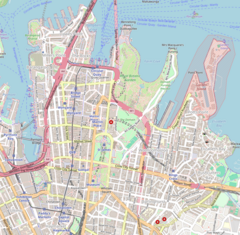
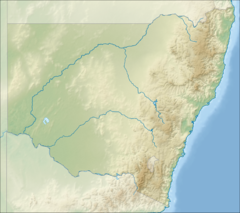
| Location in Sydney Show map of Sydney Location in New South Wales Testify map of New South Wales Location in Australia Show map of Australia | |
| General information | |
| Condition | Complete |
| Blazon | Performing arts centre |
| Architectural style | Expressionist |
| Location | Bennelong Signal, Sydney |
| Land | Australia |
| Coordinates | 33°51′31″Southward 151°12′51″Eastward / 33.85861°S 151.21417°Due east / -33.85861; 151.21417 Coordinates: 33°51′31″Southward 151°12′51″Due east / 33.85861°S 151.21417°E / -33.85861; 151.21417 |
| Elevation | 4 m (xiii ft) |
| Electric current tenants |
|
| Groundbreaking | 1 March 1959 (1959-03-01) |
| Construction started | ane March 1959 (1959-03-01) |
| Completed | 1973 (1973) |
| Opened | 20 October 1973 (1973-10-20) |
| Inaugurated | 20 October 1973 (1973-10-twenty) |
| Cost | A$102 million, equivalent to A$962 1000000 in 2018[1] |
| Customer | NSW regime |
| Owner | NSW Government |
| Superlative | 65 k (213 ft) |
| Dimensions | |
| Other dimensions |
|
| Technical details | |
| Structural system | Concrete frame & precast concrete ribbed roof |
| Design and construction | |
| Architect | Jørn Utzon |
| Structural engineer | Ove Arup & Partners |
| Principal contractor | Ceremonious & Borough (level ane), M.R. Hornibrook (level 2 and 3 and interiors) |
| Other information | |
| Seating capacity |
|
| Website | |
| sydneyoperahouse | |
| UNESCO World Heritage Site | |
| Type | Cultural |
| Criteria | i |
| Designated | 2007 (31st session) |
| Reference no. | 166rev |
| State Political party | Commonwealth of australia |
| Region | Oceania |
| Australian National Heritage Listing | |
| Blazon | Historic |
| Criteria | a, b, e, f, g, h |
| Designated | 12 July 2005 (2005-07-12) |
| Reference no. | 105738 |
| New Southward Wales Heritage Register | |
| Blazon | Built |
| Criteria | a, b, c, d, e, f, chiliad |
| Designated | iii December 2003 (2003-12-03) |
| Reference no. | 01685 |
| References | |
| Coordinates[2] | |


The Sydney Opera House is a multi-venue performing arts centre in Sydney. Located on the banks of the Sydney Harbour, it is often regarded as one of the globe'due south most famous and distinctive buildings and a masterpiece of 20th century compages.[3] [4]
Designed by Danish architect Jørn Utzon, but completed by an Australian architectural team headed past Peter Hall, the edifice was formally opened on xx Oct 1973[5] after a gestation kickoff with Utzon's 1957 selection equally winner of an international blueprint competition. The Regime of New South Wales, led past the premier, Joseph Cahill, authorised work to begin in 1958 with Utzon directing construction. The government's determination to build Utzon's blueprint is often overshadowed past circumstances that followed, including cost and scheduling overruns as well every bit the architect's ultimate resignation.[6]
The building and its surrounds occupy the whole of Bennelong Point on Sydney Harbour, between Sydney Cove and Subcontract Cove, adjacent to the Sydney primal business commune and the Purple Botanic Gardens, and close by the Sydney Harbour Bridge.
The edifice comprises multiple performance venues, which together host well over ane,500 performances annually, attended by more than than 1.ii million people.[7] Performances are presented past numerous performing artists, including three resident companies: Opera Australia, the Sydney Theatre Company and the Sydney Symphony Orchestra. As ane of the most pop visitor attractions in Australia, the site is visited by more viii one thousand thousand people annually, and approximately 350,000 visitors take a guided tour of the building each yr.[eight] The building is managed by the Sydney Opera House Trust, an bureau of the New South Wales State Government.
On 28 June 2007, the Sydney Opera Business firm became a UNESCO World Heritage Site,[9] having been listed on the (at present defunct) Register of the National Manor since 1980, the National Trust of Australia annals since 1983, the Metropolis of Sydney Heritage Inventory since 2000, the New South Wales State Heritage Register since 2003, and the Australian National Heritage List since 2005.[10] [xi] Furthermore, the Opera Business firm was a finalist in the New7Wonders of the World campaign listing.[12] [13]
Description [edit]
The facility features a modernistic expressionist design, with a serial of large precast concrete "shells",[14] each composed of sections of a sphere of 75.two metres (246 ft 8.six in) radius,[15] forming the roofs of the structure, assail a monumental podium. The edifice covers ane.8 hectares (4.4 acres) of land and is 183 k (600 ft) long and 120 m (394 ft) wide at its widest signal. It is supported on 588 concrete piers sunk equally much every bit 25 grand (82 ft) beneath sea level. The highest roof point is 67 metres above body of water-level which is the same height equally that of a 22-storey building. The roof is fabricated of 2,194 pre-bandage physical sections, which counterbalance upwardly to 15 tonnes each.[sixteen]
Although the roof structures are ordinarily referred to as "shells" (as in this article), they are precast concrete panels supported by precast physical ribs, not shells in a strictly structural sense.[17] Though the shells appear uniformly white from a distance, they really feature a subtle chevron pattern composed of 1,056,006 tiles in ii colours: sleeky white and matte cream. The tiles were manufactured by the Swedish company Höganäs AB which generally produced stoneware tiles for the newspaper-mill industry.[18]
Apart from the tile of the shells and the drinking glass curtain walls of the foyer spaces, the edifice'southward exterior is largely clad with aggregate panels composed of pink granite quarried at Tarana. Meaning interior surface treatments also include off-class concrete, Australian white birch plywood supplied from Wauchope in northern New Due south Wales, and brush box glulam.[19]
Of the two larger spaces, the Concert Hall is in the western group of shells, the Joan Sutherland Theatre in the eastern group. The calibration of the shells was chosen to reverberate the internal top requirements, with low entrance spaces, rising over the seating areas up to the high stage towers. The smaller venues (the Drama Theatre, the Playhouse and the Studio) are within the podium, below the Concert Hall. A smaller group of shells gear up to the western side of the Monumental Steps houses the Bennelong Eatery. The podium is surrounded by substantial open public spaces, and the large rock-paved forecourt area with the next monumental steps is regularly used as a performance space.
Functioning venues and facilities [edit]
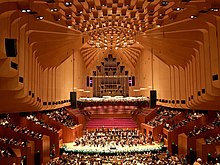
The chief Concert Hall during a operation

The Bennelong Eating place, located at the southernmost canvass
The Sydney Opera House includes a number of functioning venues:[twenty]
- Concert Hall: With two,679 seats, the dwelling of the Sydney Symphony Orchestra and used past a large number of other concert presenters. It contains the Sydney Opera House 1000 Organ, the largest mechanical tracker action organ in the globe, with over 10,000 pipes.[21]
- Joan Sutherland Theatre: A proscenium theatre with 1,507 seats,[22] the Sydney dwelling of Opera Australia and The Australian Ballet. Until 17 October 2012 it was known equally the Opera Theatre.[23] [24]
- Drama Theatre: A proscenium theatre with 544 seats, used past the Sydney Theatre Company and other trip the light fantastic toe and theatrical presenters.
- Playhouse: A non-proscenium end-stage theatre with 398 seats.
- Studio: A flexible infinite with 280 permanent seats (some of which tin be folded up) and a maximum chapters of 400, depending on configuration.
- Utzon Room: A pocket-size multi-purpose venue for parties, corporate functions and small productions (such every bit chamber music performances).
- Recording Studio
- Outdoor Forecourt: A flexible open-air venue with a broad range of configuration options, including the possibility of utilising the Monumental Steps as audition seating, used for a range of community events and major outdoor performances.
Other areas (for example the northern and western foyers) are also used for performances on an occasional basis. Venues are also used for conferences, ceremonies and social functions.
Other facilities [edit]
The building also houses a recording studio, retail shops, cafes, restaurants, bars including the Opera Bar and Opera Kitchen. Guided tours are available, including a frequent tour of the front-of-house spaces, and a daily backstage tour that takes visitors backstage to run across areas normally reserved for performers and coiffure members.
History [edit]
Construction history [edit]
Origins [edit]

Bennelong Point with tram depot in the 1920s (top left-hand side of photograph)
Planning began in the late 1940s when Eugene Goossens, the Manager of the New South Wales State Conservatorium of Music, lobbied for a suitable venue for large theatrical productions. The normal venue for such productions, the Sydney Town Hall, was non considered large plenty. By 1954, Goossens succeeded in gaining the back up of New South Wales Premier Joseph Cahill, who chosen for designs for a defended opera house. It was also Goossens who insisted that Bennelong Indicate be the site: Cahill had wanted information technology to be on or near Wynyard Railway Station in the northwest of the central business commune.[25]
An international pattern contest was launched past Cahill on 13 September 1955 and received 233 entries, representing architects from 32 countries. The criteria specified a large hall seating 3,000 and a small hall for 1,200 people, each to exist designed for dissimilar uses, including full-calibration operas, orchestral and choral concerts, mass meetings, lectures, ballet performances, and other presentations.[26]

The winner, announced in 1957, was Danish architect Jørn Utzon. Utzon's pattern was rescued by Finnish-American architect Eero Saarinen from a final cut of 30 rejects.[27] The runner-up was a Philadelphia-based squad assembled by Robert Geddes and George Qualls, both teaching at the University of Pennsylvania Schoolhouse of Blueprint. They brought together a band of Penn faculty and friends from Philadelphia architectural offices, including Melvin Brecher, Warren Cunningham, Joseph Marzella, Walter Wiseman, and Leon Loschetter. Geddes, Brecher, Qualls, and Cunningham went on to found the business firm GBQC Architects. The yard prize was 5,000 Australian pounds.[28] Utzon visited Sydney in 1957 to assist supervise the project.[29] His office moved to Palm Beach, Sydney in February 1963.[30]
Utzon received the Pritzker Compages Prize, compages's highest honour, in 2003.[31] The Pritzker Prize commendation read:
There is no doubt that the Sydney Opera Business firm is his masterpiece. It is one of the dandy iconic buildings of the 20th century, an image of great beauty that has become known throughout the globe – a symbol for not only a city but a whole country and continent.
Blueprint and structure [edit]
The Fort Macquarie Tram Depot, occupying the site at the fourth dimension of these plans, was demolished in 1958 and construction began in March 1959. It was built in three stages: phase I (1959–1963) consisted of building the upper podium; stage II (1963–1967) the construction of the outer shells; phase III (1967–1973) interior pattern and construction.
Stage I: Podium [edit]
Stage I commenced on 2 March 1959 with the construction firm Civil & Borough, monitored by the engineers Ove Arup and Partners.[32] The government had pushed for work to brainstorm early, fearing that funding, or public stance, might turn against them. All the same, Utzon had however not completed the final designs. Major structural issues notwithstanding remained unresolved. By 23 January 1961, piece of work was running 47 weeks behind,[32] mainly because of unexpected difficulties (choppy weather, unexpected difficulty diverting stormwater, structure get-go before proper construction drawings had been prepared, changes of original contract documents). Work on the podium was finally completed in February 1963. The forced early start led to significant after problems, not least of which was the fact that the podium columns were non strong plenty to support the roof structure, and had to be re-built.[33]
Phase 2: Roof [edit]
-

Podium construction complete, 1962
-

Shells construction, circa 1965
-

circa 1965
-

Tiles complete, circa 1968
The shells of the competition entry were originally of undefined geometry,[34] merely, early in the design procedure, the "shells" were perceived as a series of parabolas supported past precast concrete ribs. However, engineers Ove Arup and Partners were unable to find an acceptable solution to constructing them. The formwork for using in-situ concrete would accept been prohibitively expensive, and, considering at that place was no repetition in whatsoever of the roof forms, the construction of precast physical for each individual section would possibly have been fifty-fifty more expensive.

Sydney Opera Business firm shell ribs

The glazed ceramic tiles of the Sydney Opera Firm
From 1957 to 1963, the design squad went through at least 12 iterations of the grade of the shells trying to discover an economically acceptable form (including schemes with parabolas, circular ribs and ellipsoids) earlier a workable solution was completed. The design work on the shells involved one of the earliest uses of computers in structural analysis, to empathise the complex forces to which the shells would exist subjected.[35] [36] The computer system was also used in the associates of the arches. The pins in the arches were surveyed at the end of each day, and the information was entered into the computer then the next arch could be properly placed the following day. In mid-1961, the design team establish a solution to the problem: the shells all being created as sections from a sphere. This solution allows arches of varying length to be cast in a common mould, and a number of arch segments of common length to exist placed adjacent to one some other, to form a spherical department. With whom exactly this solution originated has been the subject of some controversy. It was originally credited to Utzon. Ove Arup's letter to Ashworth, a member of the Sydney Opera House Executive Committee, states: "Utzon came upward with an idea of making all the shells of uniform curvature throughout in both directions."[37] Peter Jones, the author of Ove Arup's biography, states that "the architect and his supporters alike claimed to recall the precise eureka moment ... ; the engineers and some of their associates, with equal conviction, recall discussion in both central London and at Ove's house."
He goes on to claim that "the existing prove shows that Arup's canvassed several possibilities for the geometry of the shells, from parabolas to ellipsoids and spheres."[35] Yuzo Mikami, a member of the design squad, presents an contrary view in his book on the projection, Utzon's Sphere.[38] [39] It is unlikely that the truth volition ever be categorically known, only in that location is a clear consensus that the design team worked very well indeed for the kickoff function of the project and that Utzon, Arup, and Ronald Jenkins (partner of Ove Arup and Partners responsible for the Opera Firm project) all played a very significant part in the design evolution.[40]
Every bit Peter Murray states in The Saga of the Sydney Opera House:[33]
... the 2 men—and their teams—enjoyed a collaboration that was remarkable in its fruitfulness and, despite many traumas, was seen past nearly of those involved in the projection equally a high point of builder/engineer collaboration.
The design of the roof was tested on scale models in wind tunnels at University of Southampton and later NPL in order to institute the wind-pressure distribution around the roof shape in very high winds, which helped in the design of the roof tiles and their fixtures.[41] [42]
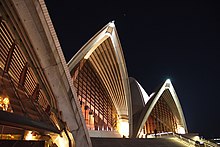
The shells of the Opera Firm at night, viewed from the south
The shells were constructed by Hornibrook Group Pty Ltd,[43] who were also responsible for structure in Stage III. Hornibrook manufactured the 2400 precast ribs and 4000 roof panels in an on-site factory and also developed the construction processes.[33] The achievement of this solution avoided the need for expensive formwork construction past allowing the utilise of precast units and it also immune the roof tiles to be prefabricated in sheets on the footing, instead of beingness stuck on individually at height.
The tiles themselves were manufactured by the Swedish company Höganäs Keramik. It took three years of development to produce the effect Utzon wanted in what became known every bit the Sydney Tile, 120mm square. It is made from dirt with a modest percent of crushed rock.[44]
Ove Arup and Partners' site engineer supervised the construction of the shells, which used an innovative adjustable steel-trussed "erection curvation" (developed past Hornibrook's engineer Joe Bertony) to support the different roofs before completion.[36] On vi April 1962, it was estimated that the Opera House would exist completed between August 1964 and March 1965.
Phase III: Interiors [edit]
-

The Concert Hall and organ
-

View from the stage of the Concert Hall.
-

View from the stage of the Joan Sutherland Theatre.
-

Interior of the Studio Theatre.
Stage III, the interiors, started with Utzon moving his unabridged office to Sydney in February 1963. Nonetheless, there was a change of government in 1965, and the new Robert Askin government declared the project under the jurisdiction of the Ministry of Public Works. Due to the Ministry's criticism of the project's costs and fourth dimension,[45] along with their impression of Utzon'south designs existence impractical, this ultimately led to his resignation in 1966 (run into below).
The price of the project then far, even in Oct 1966, was still only A$22.ix million,[46] less than a quarter of the final $102 meg price. Even so, the projected costs for the design were at this phase much more than significant.
The second stage of construction was progressing toward completion when Utzon resigned. His position was principally taken over past Peter Hall, who became largely responsible for the interior design. Other persons appointed that same year to replace Utzon were E. H. Farmer as authorities builder, D. S. Littlemore and Lionel Todd.
Following Utzon's resignation, the audio-visual advisor, Lothar Cremer, confirmed to the Sydney Opera House Executive Commission (SOHEC) that Utzon's original acoustic design allowed for but 2,000 seats in the main hall and further stated that increasing the number of seats to 3,000 as specified in the cursory would be disastrous for the acoustics. According to Peter Jones, the stage designer, Martin Carr, criticised the "shape, height and width of the stage, the physical facilities for artists, the location of the dressing rooms, the widths of doors and lifts, and the location of lighting switchboards."[47]
Significant changes to Utzon'southward design [edit]

The foyer of the Joan Sutherland Theatre, showing the internal structure and steel framing of the glass curtain walls; the last constructions were modified from Utzon's original designs

The antechamber of the Concert Hall
- The major hall, which was originally to exist a multipurpose opera/concert hall, became solely a concert hall, chosen the Concert Hall. The pocket-size hall, originally for stage productions merely, incorporated opera and ballet functions and was called the Opera Theatre, later renamed the Joan Sutherland Theatre. As a event, the Joan Sutherland Theatre is inadequate to stage large-scale opera and ballet. A theatre, a picture palace and a library were also added. These were later changed to two live drama theatres and a smaller theatre "in the round". These now incorporate the Drama Theatre, the Playhouse and the Studio respectively. These changes were primarily because of inadequacies in the original contest brief, which did not get in adequately articulate how the Opera House was to be used. The layout of the interiors was inverse, and the stage machinery, already designed and fitted inside the major hall, was pulled out and largely thrown away, as detailed in the 1968 BBC TV documentary Autopsy on a Dream, which "chronicles the full spectrum of controversy surrounding the construction of the Sydney Opera House".[48]
- Externally, the cladding to the podium and the paving (the podium was originally not to exist clad down to the h2o, only to be left open up).
- The construction of the glass walls (Utzon was planning to employ a system of prefabricated plywood mullions, but a different system was designed to deal with the glass).
- Utzon's plywood corridor designs, and his audio-visual and seating designs for the interior of both major halls, were scrapped completely. His blueprint for the Concert Hall was rejected every bit it only seated 2000, which was considered insufficient.[35] Utzon employed the audio-visual consultant Lothar Cremer, and his designs for the major halls were subsequently modelled and found to be very practiced. The subsequent Todd, Hall and Littlemore versions of both major halls take some issues with acoustics, particularly for the performing musicians. The orchestra pit in the Joan Sutherland Theatre is cramped and dangerous to musicians' hearing.[49] The Concert Hall has a very high roof, leading to a lack of early reflections onstage—perspex rings (the "acoustic clouds") hanging over the stage were added soon before opening in an (unsuccessful) endeavour to address this problem.
Completion and cost [edit]
The Opera Firm was formally completed in 1973, having cost $102 one thousand thousand.[50] H.R. "Sam" Hoare, the Hornibrook director in charge of the project, provided the following approximations in 1973: Stage I: podium Civil & Civic Pty Ltd approximately $5.5m. Stage Two: roof shells M.R. Hornibrook (NSW) Pty Ltd approximately $12.5m. Stage Three: completion The Hornibrook Group $56.5m. Separate contracts: stage equipment, stage lighting and organ $nine.0m. Fees and other costs: $16.5m.
The original cost and scheduling estimates in 1957 projected a cost of £3,500,000 ($7 million) and completion appointment of 26 January 1963 (Australia 24-hour interval).[35] In reality, the project was completed ten years late and ane,357% over budget in existent terms.
Strike and Workers' Command [edit]
In 1972, a structure worker was fired, leading the BLF affiliated workers to need his rehiring and a 25% wage increment. In response to this, all the workers were fired, and in revenge the workers broke into the construction site with a crowbar and brought their own toolboxes. Workers' control was applied to the site for five weeks as the construction workers worked 35 hours a week with improved morale, more efficient organization and fewer people skipping piece of work. The workers agreed to end their piece of work-in when management agreed to give them a 25% wage increase, the right to elect their foremen, four weeks almanac leave and a big payment for their troubles.[51]
Utzon and his resignation [edit]

The building illuminated at night
Before the Sydney Opera House competition, Jørn Utzon had won seven of the eighteen competitions he had entered merely had never seen whatsoever of his designs built.[52] Utzon'due south submitted concept for the Sydney Opera House was almost universally admired and considered groundbreaking. The Assessors Report of January 1957, stated:
The drawings submitted for this scheme are simple to the point of being diagrammatic. Nevertheless, every bit we have returned again and again to the report of these drawings, nosotros are convinced that they present a concept of an Opera House which is capable of condign ane of the groovy buildings of the world.
For the first stage, Utzon worked successfully with the rest of the pattern team and the client, but, as the project progressed, the Cahill government insisted on progressive revisions. They also did non fully appreciate the costs or piece of work involved in design and construction. Tensions betwixt the client and the design team grew further when an early on start to construction was demanded despite an incomplete blueprint. This resulted in a standing series of delays and setbacks while various technical applied science issues were existence refined. The building was unique, and the problems with the pattern problems and cost increases were exacerbated by outset of piece of work before the completion of the final plans.
Afterward the 1965 election of the Liberal Political party, with Robert Askin becoming Premier of New S Wales, the relationship of client, architect, engineers and contractors became increasingly tense. Askin had been a "vocal critic of the project prior to gaining part."[53] His new Minister for Public Works, Davis Hughes, was even less sympathetic. Elizabeth Farrelly, an Australian architecture critic, wrote that:
at an election night dinner political party in Mosman, Hughes' daughter Sue Burgoyne boasted that her father would before long sack Utzon. Hughes had no interest in art, architecture or aesthetics. A fraud, as well as a philistine, he had been exposed before Parliament and dumped as Country Party leader for 19 years of falsely claiming a university degree. The Opera Firm gave Hughes a 2nd take chances. For him, as for Utzon, it was all near control; most the triumph of homegrown mediocrity over foreign genius.[53]
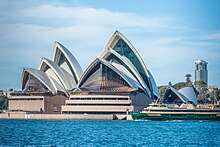
The Opera House seen from the north
Differences ensued. Ane of the first was that Utzon believed the clients should receive data on all aspects of the design and construction through his practice, while the clients wanted a organization (notably drawn in sketch form by Davis Hughes) where architect, contractors, and engineers each reported to the client direct and separately. This had peachy implications for procurement methods and cost command, with Utzon wishing to negotiate contracts with chosen suppliers (such as Ralph Symonds for the plywood interiors) and the New Southward Wales regime insisting contracts be put out to tender.[33]
Utzon was highly reluctant to respond to questions or criticism from the customer'due south Sydney Opera House Executive Committee (SOHEC).[54] Withal, he was profoundly supported throughout by a member of the committee and one of the original competition judges, Harry Ingham Ashworth. Utzon was unwilling to compromise on some aspects of his designs that the clients wanted to change.
Utzon'due south ability was never in doubt, despite questions raised by Davis Hughes, who attempted to portray Utzon equally an impractical dreamer. Ove Arup actually stated that Utzon was "probably the best of any I have come up beyond in my long experience of working with architects"[55] and: "The Opera House could go the world'south foremost contemporary masterpiece if Utzon is given his head."
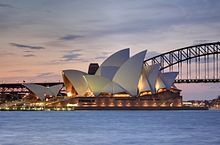
In October 1965, Utzon gave Hughes a schedule setting out the completion dates of parts of his work for stage III.[ commendation needed ] Utzon was at this time working closely with Ralph Symonds, a manufacturer of plywood based in Sydney and highly regarded by many, despite an Arup engineer warning that Ralph Symonds'southward "knowledge of the design stresses of plywood, was extremely sketchy" and that the technical advice was "simple to say the least and completely useless for our purposes." Australian compages critic Elizabeth Farrelly has referred to Ove Arup's projection engineer Michael Lewis as having "other agendas".[53] In any case, Hughes shortly after withheld permission for the structure of plywood prototypes for the interiors,[ citation needed ] and the relationship betwixt Utzon and the customer never recovered. Past February 1966, Utzon was owed more $100,000 in fees.[56] Hughes then withheld funding so that Utzon could not fifty-fifty pay his own staff. The government minutes tape that post-obit several threats of resignation, Utzon finally stated to Davis Hughes: "If yous don't do information technology, I resign." Hughes replied: "I take your resignation. Thanks very much. Farewell."[57]

The Opera Business firm viewed from the south
Utzon left the project on 28 Feb 1966. He said that Hughes's refusal to pay him whatever fees and the lack of collaboration acquired his resignation and later described the situation as "Malice in Blunderland". In March 1966, Hughes offered him a subordinate role as "design architect" under a panel of executive architects, without any supervisory powers over the House's construction, merely Utzon rejected this. Utzon left the land never to render.
Following the resignation, there was great controversy nearly who was in the correct and who was in the wrong. The Sydney Morning Herald initially opined: "No architect in the world has enjoyed greater freedom than Mr Utzon. Few clients have been more patient or more generous than the people and the Regime of NSW. One would non like history to record that this partnership was brought to an terminate by a fit of atmosphere on the one side or by a fit of meanness on the other." On 17 March 1966, the Herald offered the view that:[58] "It was not his [Utzon'south] error that a succession of Governments and the Opera Firm Trust should then signally take failed to impose any command or club on the project ... his concept was so daring that he himself could solve its issues only step by stride ... his insistence on perfection led him to alter his pattern as he went along."
The Sydney Opera Firm opened the way for the immensely circuitous geometries of some modern architecture. The blueprint was 1 of the get-go examples of the utilise of estimator-aided design to blueprint complex shapes. The pattern techniques adult past Utzon and Arup for the Sydney Opera Firm have been further adult and are now used for architecture, such every bit works of Gehry and blobitecture, equally well equally most reinforced concrete structures. The blueprint is as well one of the first in the earth to utilize araldite to glue the precast structural elements together and proved the concept for future apply.
It was also a first in mechanical applied science. Another Danish firm, Steensen Varming, was responsible for designing the new air conditioning establish, the largest in Commonwealth of australia at the time, supplying over 600,000 cubic feet (17,000 grand3) of air per minute,[59] using the innovative idea of harnessing the harbour water to create a water-cooled heat pump arrangement that is still in operation today.[60]
Opening [edit]

Tourists on the steps of the Opera House
The Sydney Opera Business firm was formally opened by Queen Elizabeth II, Queen of Australia on twenty October 1973. A large crowd attended. Utzon was not invited to the ceremony, nor was his name mentioned. The opening was televised and included fireworks and a performance of Beethoven's Symphony No. 9.[61]
Reconciliation with Utzon; building refurbishment [edit]
In the late 1990s, the Sydney Opera Firm Trust resumed communication with Utzon in an try to effect a reconciliation and to secure his involvement in future changes to the edifice. In 1999, he was appointed by the trust as a pattern consultant for hereafter piece of work.[62]
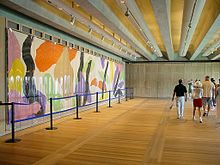
The Utzon Room: rebuilt nether Utzon in 2000 with his tapestry, Homage to Carl Philipp Emanuel Bach
In 2004, the first interior space rebuilt to an Utzon blueprint was opened and renamed "The Utzon Room" in his award. It contains an original Utzon tapestry (xiv.00 x iii.70 metres) chosen Homage to Carl Philipp Emanuel Bach.[63] In Apr 2007, he proposed a major reconstruction of the Opera Theatre, equally it was so known.[64] Utzon died on 29 November 2008.[65]
A country memorial service, attended past Utzon'southward son Jan and girl Lin, was held in the Concert Hall on 25 March 2009 featuring performances, readings and recollections from prominent figures in the Australian performing arts scene.
Refurbished Western Foyer and accessibility improvements were commissioned on 17 November 2009, the largest building project completed since Utzon was re-engaged in 1999. Designed by Utzon and his son January, the project provided improved ticketing, toilet and cloaking facilities. New escalators and a public elevator enabled enhanced admission for the disabled and families with prams. The prominent paralympian athlete Louise Sauvage was announced as the building's "accessibility ambassador" to advise on further improvements to aid people with disabilities.[66]
On 29 March 2016, an original 1959 tapestry by Le Corbusier (2.18 x 3.55 metres), commissioned by Utzon to be hung in the Sydney Opera Business firm and chosen Les Dés Sont Jetés (The Dice Are Cast), was finally unveiled in situ later being owned by the Utzon family and held at their dwelling house in Denmark for over 50 years. The tapestry was bought at auction by the Sydney Opera Business firm in June 2015. Information technology at present hangs in the building's Western Anteroom and is accessible to the public.[67]
In the second half of 2017, the Joan Sutherland Theatre was closed to supplant the phase machinery and for other works.
Architectural design office of Peter Hall [edit]
Later the resignation of Utzon, the Minister for Public Works, Davis Hughes, and the Government Architect, Ted Farmer, organised a team to bring the Sydney Opera House to completion. The architectural work was divided betwixt three appointees who became the Hall, Todd, Littlemore partnership. David Littlemore would manage construction supervision, Lionel Todd contract documentation, while the crucial role of design became the responsibleness of Peter Hall.[68] : 45
Peter Hall (1931–1995) completed a combined arts and compages degree at Sydney University. Upon graduation a travel scholarship enabled him to spend twelve months in Europe during which time he visited Utzon in Hellebæk.[69] Returning to Sydney, Hall worked for the Government Architect, a branch of the NSW Public Works Department. While there he established himself as a talented design architect with a number of court and academy buildings, including the Goldstein Hall at the University of New S Wales, which won the Sir John Sulman Medal in 1964.
Hall resigned from the Government Architects office in early 1966 to pursue his own practise. When approached to have on the design role, (subsequently at least ii prominent Sydney architects had declined), Hall spoke with Utzon by phone before accepting the position. Utzon reportedly told Hall: he (Hall) would non be able to stop the task and the Authorities would have to invite him back.[68] : 46 Hall also sought the advice of others, including builder Don Gazzard who warned him acceptance would be a bad career move equally the projection would "never exist his ain".[68] : 47 [70]
Hall agreed to accept the function on the condition there was no possibility of Utzon returning. Even so, his appointment did not go down well with many of his fellow architects who considered that no one but Utzon should complete the Sydney Opera House.[69] Upon Utzon's dismissal, a rally of protest had marched to Bennelong Point. A petition was also circulated, including in the Government Architects office. Peter Hall was one of the many who had signed the petition that called for Utzon'due south reinstatement.[69]
When Hall agreed to the blueprint function and was appointed in April 1966, he imagined he would find the design and documentation for the Stage 3 well avant-garde. What he institute was an enormous amount of work ahead of him with many aspects completely unresolved by Utzon in relation to seating capacity, acoustics and construction.[68] : 42 In addition Hall establish the project had proceeded for ix years without the development of a curtailed client cursory. To bring himself up to speed, Hall investigated concert and opera venues overseas and engaged stage consultant Ben Schlange and audio-visual consultant Wilhelm Jordan, while establishing his squad. In consultation with all the potential building users, the first Review of Program was completed in January 1967. The most significant conclusion reached past Hall was that concert and opera were incompatible in the same hall.[68] : 53 Although Utzon had sketched ideas using plywood for the great enclosing glass walls, their structural viability was unresolved when Hall took on the design role.[68] : 49 With the ability to delegate tasks and effectively coordinate the work of consultants, Hall guided the project for over five years until the opening twenty-four hour period in 1973.
A former Government Architect, Peter Webber, in his volume Peter Hall: the Phantom of the Opera House, concludes: when Utzon resigned no one was better qualified (than Hall) to rise to the challenge of completing the design of the Opera Business firm.[68] : 126
Performance firsts [edit]
During the construction phase, lunchtime performances were ofttimes bundled for the workers, with American vocaliser Paul Robeson the first artist to perform, in 1960.
Various performances were presented prior to the official opening:
- The first solo pianoforte recital was in the Concert Hall on x April 1973, played by Romola Costantino to an invited audition.[71]
- The outset opera performed was Sergei Prokofiev's War and Peace, in what was then known every bit the Opera Theatre on 28 September 1973, conducted past the Australian Opera's Music Managing director, Edward Downes. (It had been intended that Peter Sculthorpe'southward piece of work Rites of Passage would have this honor, but it was not ready on time. Rites of Passage was premiered almost exactly a yr later, on 27 September 1974.)[ citation needed ]
- The first evening performance of an opera was Larry Sitsky's The Fall of the House of Usher, conducted past Male monarch Hobcroft[72] and paired with Dalgerie by James Penberthy, to a libretto by Mary Durack; it took place on 25 July 1973.[73]
- The kickoff public concert in the Concert Hall took place on 29 September 1973. It was an all-Wagner orchestral concert performed by the Sydney Symphony Orchestra, conducted by Charles Mackerras and with Birgit Nilsson as the soprano soloist. The get-go music played was the Prelude to Die Meistersinger von Nürnberg. The concert closed with the Immolation Scene from Götterdämmerung.[ citation needed ]
After the opening:
- The first violin and piano recital was given by Wanda Wiłkomirska, with pianist Geoffrey Parsons.[74]
Public and commemorative events [edit]

In 1993, Constantine Koukias was commissioned by the Sydney Opera House Trust in association with REM Theatre to compose Icon, a large-scale music theatre piece for the 20th ceremony of the Sydney Opera House.[75]
During the 2000 Summertime Olympics, the venue served as the focal indicate for the triathlon events. The event had a 1.5 km (0.9 mi) swimming loop at Farm Cove, along with competitions in the neighbouring Royal Botanical Gardens for the cycling and running portions of the outcome.[76]
Since 2013, a group of residents from the nearby Bennelong Apartments (improve known as 'The Toaster'), calling themselves the Sydney Opera House Concerned Citizens Group, have been campaigning against Forecourt Concerts on the grounds that they exceed noise levels outlined in the development blessing (DA). In February 2022 the NSW Department of Planning and the Environment handed downwardly a $15,000 fine to the Sydney Opera House for breach of allowed noise levels at a concert held in Nov 2015. Nevertheless, the DA was amended in 2022 to let an increase in noise levels in the forecourt by five decibels. The residents opposing the concerts argue that a new DA should have been filed rather than an amendment.[77] [78]
The Sydney Opera House sails formed a graphic projection-screen in a lightshow mounted in connection with the International Armada Review in Sydney Harbour on 5 October 2013.[79]
On 31 December 2013, the venue's 40th anniversary year, a New Year firework display was mounted for the first time in a decade.[80] The Sydney Opera House hosted an event, 'the biggest blind date' on Friday 21 Feb 2022 that won an historic Guinness World Record.[81] The longest continuous serving employee was commemorated on 27 June 2018, for 50 years of service.[82]
On 14 June 2019, a state memorial service for former Australian Prime Minister Bob Hawke was held at the Sydney Opera House.
Advertising controversy [edit]
On 5 Oct 2022 the Opera House chief executive Louise Herron clashed with Sydney radio commentator Alan Jones, who chosen for her sacking for refusing to permit Racing NSW to use the Opera Business firm sails to advertise The Everest horse race. Within hours, NSW Premier Gladys Berejiklian overruled Herron. Two days afterward, Prime Minister Scott Morrison supported the decision, calling the Opera Firm "the biggest billboard Sydney has".[83] The NSW Labor Party leader, Luke Foley, and senior federal Labor frontbencher Anthony Albanese had supported the proposal.[84] The political view was not supported by significant public opinion, with a petition against the advert collecting over 298,000 names past 9 October 2018.[85] 235,000 printed petition documents were presented to the NSW Parliament in the morning.[86] A survey conducted on 8 October past market research firm Micromex found that 81% of those surveyed were not supportive of the premier's management.[87]
Notable performances [edit]
- 1960 – The outset person to perform at the Sydney Opera House was Paul Robeson – he sang "Ol' Man River" to the structure workers as they ate lunch.
- 1973 – Sergei Prokofiev's War and Peace, on 28 September 1973.[88]
- 1973 - Opening gala concert in the concert hall with music by Richard Wagner. Sydney Symphony Orchestra conducted past Sir Charles Mackerras. Soloist: The great Swedish soprano Birgit Nilsson, on 29 September 1973.
- 1974 – Opera vocalizer Joan Sutherland performed for the first time in the theatre that would be named for her.
- 1978 – Irish rockers Thin Lizzy (played a gratis concert on the steps) and was brought out on the record Thin Lizzy Live at Sydney Harbour '78.[89]
- 1985 – Ray Lawler's classic Doll Trilogy.
- 1987 – Pope John Paul II gave a voice communication in the Concert Hall during his visit to Australia.
- 1990 – Nelson Mandela addressed a crowd of 40,000 and attended a choral functioning of Nkosi Sikelel' iAfrica ("God Bless Africa").
- 1991 – Joan Sutherland gives her terminal performance.
- 1995 – Bernard Shaw'south Saint Joan: starring Jacqueline McKenzie in the title role of Joan of Arc.[ninety]
- 1996 – Crowded House played their tape-breaking Farewell to the World concert on the steps.
- 1999 - Inaugural Message Sticks Festival.[ citation needed ]
- 2000 – Swimmer Samantha Riley stands on superlative of one of the Concert Hall's shells with the Olympic Torch, before sending the flame on its concluding journey to lite the cauldron at Stadium Australia.[91]
- 2003 – Pulitzer Prize winning play Proof by David Auburn, starring Jacqueline McKenzie and Barry Otto.
- 2004 – Canadian vocalizer Michael Bublé performed in the Concert Hall.
- 2008 – Oprah Winfrey filmed her Ultimate Australian Adventure in the forecourt.[92]
- 2008 – First Bright Live Music program curated past Brian Eno.
- 2008 - Premiere operation of "Angels in the Architecture" past Frank Ticheli, a air current band composition inspired past the opera house itself. Conducted by Matthew George.
- 2020 - Kickoff Six performance in Australia was held in The Studio theatre, making information technology one of the commencement hit musical performances in The Studio theatre.
Awards [edit]
- RAIA Merit Award, 1974.
- Meritorious Lighting Honor of the Illuminating Engineering Guild of Australia, 1974.
- RAIA Borough Design Award, 1980.
- RAIA Commemorative Award, Jørn Utzon – Sydney Opera House, 1992.
Cultural references [edit]
The Opera House (often along with the nearby Sydney Harbour Bridge), is frequently used in establishing shots for films and tv to place the setting as Sydney and/or Commonwealth of australia.
- The Sydney Opera House appeared on the encompass of the Phoenix Force risk novel Down Under Thunder in 1986.
- The Sydney Opera House appeared in the 1990 Disney animated moving picture The Rescuers Downwardly Under.
- In the 1991 season 5, episode 5 of Inspector Morse, titled "Promised Land", Morse climbs the steps at the cease of the episode to attend an opera performance.
- Near the end of the 1996 moving picture Independence Twenty-four hour period, the Sydney Opera Firm appeared later an alien ship almost Sydney was destroyed.
- The Sydney Opera House appeared in the 2003 Disney/Pixar animated film Finding Nemo.
- The Sydney Opera House featured in the 2004 Godzilla picture show, Godzilla Final Wars, in which the titular character dispatched an enemy, Zilla, destroying the famous landmark in the procedure.
- The Sydney Opera House appeared in the last scene of 2007 film Sunshine, directed by Danny Boyle.
- In Improve Call Saul, the male parent of Werner Ziegler, a High german engineer who helped build Gus Fring's drug laboratory, had reportedly worked on the structure of the Sydney Opera Business firm.
- The Opera House appeared during the closing credits of the 2011 film Cars 2, in which the building'south podium was modelled on the front end of a Holden FC.
- In the 2013 video game SimCity the building is featured as a placeable landmark building.[93]
- In the 2022 superhero film 10-Men: Apocalypse, the building and other parts of Sydney are destroyed when Magneto manipulates the Earth'due south magnetic poles.
- In the 2022 4X video game Civilisation 6, the Opera House is a constructible Atomic Era wonder which grants bonuses to a civilization's cultural output and points toward earning musicians.
See also [edit]
- Auditorio de Tenerife – a modern structure in Canary Islands, Spain with a similar pattern
- Australian landmarks
- Clyde Auditorium – a modern construction in Scotland with a visually similar design
- List of official openings by Elizabeth II in Commonwealth of australia
- Lotus Temple – a modern structure in Republic of india with a similar pattern
- Man O'War Steps
- Wonders of the Earth
- Mathematics and fine art
References [edit]
- ^ "Inflation Calculator". RBA. fourteen February 1966. Archived from the original on 3 March 2017. Retrieved 10 March 2017.
- ^ Topographic maps 1:100000 9130 Sydney and one:25000 91303N Parramatta River
- ^ Environment, Department of the (23 Apr 2008). "World Heritage Places – The Sydney Opera House – Earth Heritage values". www.environment.gov.au. Archived from the original on 10 May 2016. Retrieved 10 May 2016.
- ^ Maher, Alannah (xxx July 2021). "7 Sydney Opera House designs that never saw the light of twenty-four hour period". Time Out . Retrieved 4 November 2021.
- ^ "Sydney Opera House history". Sydney Opera Business firm Official Site. Archived from the original on 20 October 2013. Retrieved 17 October 2013.
- ^ "2003 Laureate". The Pritzker Architecture Prize. The Hyatt Foundation. Archived from the original on 22 Dec 2015. Retrieved xix December 2015.
- ^ "Sydney Opera House 2022 Annual Study – Performing Arts" (PDF) . Retrieved 19 December 2015. [ permanent dead link ]
- ^ "How practice you value an icon? The Sydney Opera House: economical, cultural and digital value" (PDF). Deloite Access Economics. 2010. p. lxx. Archived from the original (PDF) on 22 December 2015. Retrieved 19 December 2015.
- ^ Braithwaite, David (28 June 2007). "Opera House wins top status". The Sydney Morn Herald. Archived from the original on 1 July 2007. Retrieved 28 June 2007.
- ^ "Sydney Opera House". New South Wales State Heritage Register. Office of Environs and Heritage. H01685. Retrieved 3 September 2017.
- ^ "Sydney Opera House, 2 Round Quay E, Sydney, NSW, Australia". Australian Heritage Database. Department of the Environment and Energy, Australian Government. 12 July 2005. Retrieved 21 September 2017.
- ^ "New7Wonders of the Globe". World of New7Wonders.
- ^ "Sydney Opera House short-listed for new 'Seven Wonders'". ABC News.
- ^ Shells of the Sydney Opera Firm, The Imperial Society of New South Wales Archived 27 September 2011 at the Wayback Automobile
- ^ "Roof Cladding of the Sydney Opera Business firm", Periodical and Proceedings of the Purple Society of New South Wales, Volume 106 Parts one and 2, pp. xviii–32, issued 21 Nov 1973 (Note: The paper is contradictory, giving both radius and diameter equally over 246 ft. It is unlikely to be the bore as the building's tiptop of 213 ft makes that illogical.) Archived 27 September 2011 at the Wayback Car
- ^ "Sydney Opera Business firm: 40 fascinating facts". Telegraph.co.great britain. 24 Oct 2013.
- ^ "Sydney Opera Business firm". Tom Fletcher. Archived from the original on 27 September 2007. Retrieved 10 February 2008.
- ^ Utzon, J (2002). Sydney Opera Business firm Utzon design principles (PDF). Sydney: Sydney Opera Business firm Trust. p. 20. Archived from the original (PDF) on 26 February 2009.
- ^ Littlemore, D.S. Sydney Opera Business firm, Anatomy of Stage Three construction and completion: a general index. Public Works Department, NSW.
- ^ "Sydney Opera House venues". sydneyoperahouse.com. Archived from the original on 16 April 2015. Retrieved 13 April 2015.
- ^ Sydney Opera Business firm Grand Organ specification Archived 5 September 2012 at the Wayback Machine
- ^ "Joan Sutherland Theatre: Technical and Production Information" (PDF). Sydney Opera House. June 2012. p. 6. Archived (PDF) from the original on iv Nov 2018. Retrieved 4 November 2018.
- ^ "Opera Theatre Officially Renamed Joan Sutherland Theatre" (Printing release). Sydney Opera Firm. 16 October 2012. Archived from the original on 18 Oct 2012. Retrieved nineteen October 2012.
- ^ "Opera House theatre to exist renamed after Sutherland". Australian Broadcasting Corporation. 17 October 2012. Archived from the original on 18 October 2012. Retrieved 19 October 2012.
- ^ "Sydney Architecture Images- Sydney Opera House". Sydneyarchitecture.com. Archived from the original on 24 Dec 2010. Retrieved 9 July 2010.
- ^ Ziegler, Oswald (1973). Sydney Builds an Opera House. Oswald Ziegler Publications. p. 35.
- ^ Geddes, Robert (2013). Watson, Anne (ed.). Edifice a Masterpiece: The Sydney Opera House. Sydney: Powerhouse Press. p. 56. ISBN9780853319412.
- ^ "Eric Ellis interview with Utzon in the Sydney Morning Herald Adept Weekend". Ericellis.com. 31 October 1992. Archived from the original on 26 July 2002. Retrieved 2 December 2008.
- ^ "Millennium Masterwork: Jorn Utzon'south Sydney Opera House". Hugh Pearman. Gabion. Archived from the original on 26 September 2007. Retrieved 28 June 2007.
- ^ Drew, Philip, "The Masterpiece: Jørn Utzon: a secret life", Hardie Grant Books, 1999
- ^ "Joern Utzon dead". The Sydney Morning time Herald. 30 Nov 2008. Archived from the original on 4 Nov 2012. Retrieved 23 September 2013.
- ^ a b Sydney Compages Archived 27 September 2007 at the Wayback Auto. Retrieved ane November 2008.
- ^ a b c d Murray, Peter (2004). The Saga of the Sydney Opera House. London: Spon Press. ISBN0-415-32521-8.
- ^ Arup, Ove and Zunz, Thousand.J.: Commodity in Structural Engineer Volume 47, March 1969
- ^ a b c d Jones, Peter: Ove Arup: Masterbuilder of the Twentieth Century. Yale Academy Press, 2006.
- ^ a b Nagesh, Ashitha (thirteen April 2019). "Joseph Bertony: The spy who helped mastermind the Sydney Opera House". BBC News.
- ^ page 199
- ^ Bentley, Paul (September 2001). "A Matter of Integrity – A Review of Yuzo Mikami's Utzon's Sphere". The Wolanski Foundation. Archived from the original on 2 Jan 2007. Retrieved 30 January 2007.
- ^ Mikami, Yuzo: Utzon's Sphere, Tokyo: Shoku Kusha. 2001.
- ^ Hunt, Tony (October 2001). "Utzon'due south Sphere: Sydney Opera House—How It Was Designed and Built—Review". EMAP Architecture, Gale Group. Archived from the original on 19 December 2006. Retrieved 30 Jan 2007.
- ^ "Model of Sydney Opera Firm, 1960". Powerhouse Museum – Collection Database. 2014. Archived from the original on half-dozen May 2014. Retrieved half dozen May 2014.
- ^ "Building the Sydney Opera House". npl.co.uk. 2014. Archived from the original on 6 May 2014. Retrieved 6 May 2014.
- ^ "Bilfinger Berger corporate history". Bilfingerberger.com. Archived from the original on 24 March 2010. Retrieved 23 September 2013.
- ^ "sydneyoperahouse.com".
- ^ "Sydney Opera House – the Builder – Sydney Opera House". www.sydneyoperahouse.com. Archived from the original on 13 May 2016. Retrieved x May 2016.
- ^ Sydney Architecture Archived 27 September 2007 at the Wayback Machine. Retrieved ane December 2008.
- ^ page203
- ^ Anderson, Doug: Review of rediscovered Sydney Opera Firm film Autopsy on a Dream Archived v March 2022 at the Wayback Auto at The Guardian, 21 October 2013
- ^ Morgan, Joyce (November 2006). "The phantoms that threaten the Opera House". The Sydney Forenoon Herald. Archived from the original on 16 October 2007. Retrieved 13 March 2007.
- ^ New South Wales Regime, Section of Commerce, [1] Archived 26 Nov 2022 at the Wayback Motorcar Accessed 3 December 2014
- ^ Ness, Immanuel (2014). New Forms of Worker Arrangement: The Syndicalist and Autonomist Restoration of Class Struggle Unionism - Chapter 10: Doing without the boss: Workers' Control Experiments in Australia in the 1970s.
- ^ page174
- ^ a b c Farrelly, Elizabeth (30 Nov 2008). "Loftier noon at Bennelong Point". Archived from the original on 7 Baronial 2015. Retrieved 3 Dec 2014.
- ^ page 191
- ^ page 209
- ^ "High noon at Bennelong Point". The Sydney Morning Herald. 1 December 2008. Archived from the original on 7 August 2015. Retrieved iii December 2014.
- ^ page224
- ^ page 228
- ^ Sunday Mail, nine Apr 1972
- ^ A. Edifice a masterpiece 2006
- ^ Lewis, Wendy; Balderstone, Simon; Bowan, John (2006). Events That Shaped Australia. New Holland. pp. 239–243. ISBN978-i-74110-492-9.
- ^ Sydney Opera Business firm Media Release (August 1999). "Utzon Appointment: 'Reunites The Man and his Masterpiece'". Archived from the original on 18 Nov 2006. Retrieved 13 March 2007.
- ^ Chiefengineer.org. "The Sydney Opera House". Archived from the original on 8 February 2007. Retrieved xiii March 2007.
- ^ Benns, Matthew (viii April 2007). "Utzon wants to tear up floor of the Opera House". The Sydney Morning Herald. Archived from the original on 28 Apr 2007. Retrieved 12 April 2007.
- ^ "Sydney Opera Firm designer Joern Utzon dies at 90". Associated Press. 29 November 2008. Archived from the original on 24 October 2016. Retrieved 24 October 2016.
- ^ Sydney Opera House: Access Strategic Plan, 2013–2015 [ permanent dead link ] on official website
- ^ Steph Harmon (29 March 2016). "When Utzon met Le Corbusier: Sydney Opera House unveils 'eye-catching' tapestry". The Guardian . Retrieved sixteen January 2022.
- ^ a b c d eastward f thousand Webber, Peter (2012). Peter Hall: the Phantom of the Opera House. The Watermark Press. ISBN978-0-949284-95-2.
- ^ a b c ABC, The Opera House Project, online
- ^ The Poisoned Chalice by Anne Watson
- ^ Bentley, Paul. "The Wolanski Foundation". Twf.org.au. Archived from the original on 27 January 2014. Retrieved 23 September 2013.
- ^ "Suzuki Talent Education Association of Australia (WA) Inc". Suzukimusicwa.com.au. Archived from the original on xxx December 2012. Retrieved 23 September 2013.
- ^ Griffel, Margaret Ross; Block, Adrienne Fried (1999). Operas in English: A Lexicon. Greenwood Printing. ISBN978-0-313-25310-2.
- ^ "Interview with Wanda Wilkomirska". Sigridharris.wordpress.com. 25 November 2007. Archived from the original on 8 Nov 2012. Retrieved 23 September 2013.
- ^ "AusStage". www.ausstage.edu.au. Archived from the original on 5 August 2016. Retrieved 29 Nov 2016.
- ^ 2000 Summertime Olympics official study. Archived ix November 2000 at the Wayback Machine Book i. pp. 136–37.
- ^ Boland, Michaela (22 February 2017). "Noise fine: Toaster folks' outset win over Opera Business firm concerts". The Australian . Retrieved 10 July 2017.
- ^ Newstead, Al (23 February 2017). "Sydney Opera Business firm fined $fifteen,000 post-obit 'Toaster' noise complaints". TripleJ. Archived from the original on 17 June 2017. Retrieved 10 July 2017.
- ^ First expect at the International Fleet Review Spectacular Archived 26 December 2013 at the Wayback Auto Preview at Navy Daily (official periodical), 5 Baronial 2013
- ^ Chettle, Nicole (30 December 2013). "NYE fireworks return to the Sydney Opera House". ABC News. Archived from the original on iv January 2014. Retrieved 4 January 2014.
- ^ "CitySwoon holds the official Guinness Earth Record® for the world'south biggest bullheaded appointment". Archived from the original on fourteen September 2017. Retrieved 21 June 2017.
- ^ "Curtain call for Sydney Opera House'due south longest serving employee – ABC News (Australian Broadcasting Corporation)". mobile.abc.cyberspace.au. Archived from the original on xviii July 2018. Retrieved nineteen July 2018.
- ^ "PM Scott Morrison says Opera House is 'the biggest billboard Sydney has'". ABC News. 7 October 2018. Archived from the original on 7 Oct 2018. Retrieved seven October 2018.
- ^ "'It's not a billboard': acrimony at use of Sydney Opera House for horse racing ads". The Guardian. 6 October 2018. Archived from the original on viii October 2018. Retrieved 9 October 2018.
- ^ "Protesters Shine Lights Onto Opera House – 10 daily". tendaily.com.au. Archived from the original on nine October 2018. Retrieved nine October 2018.
- ^ "Petition supporting Opera Business firm boss surges past 265,000 signatures". The Standard mandarin. 9 Oct 2018. Archived from the original on nine October 2018. Retrieved 9 October 2018.
- ^ Snowfall, Jacob Saulwick, Jenny Noyes, Deborah (nine October 2018). "Eight out of 10 in NSW opposed to Berejiklian's Opera House sails bargain: survey". The Sydney Morn Herald. Archived from the original on 9 October 2018. Retrieved ix October 2018.
- ^ Porter, Lizzie (four February 2016). "Sydney Opera House: 40 fascinating facts". The Telegraph. ISSN 0307-1235. Archived from the original on 31 January 2018. Retrieved 13 February 2018.
- ^ "Timeline: 40 years of the Sydney Opera House". ABC News. 20 October 2013. Archived from the original on 21 October 2013. Retrieved 12 February 2018.
- ^ "The Sydney Morning Herald from Sydney, New South Wales on July 6, 1995 · Page 20". Newspapers.com. Archived from the original on 12 February 2018. Retrieved 12 Feb 2018.
- ^ "Timeline: twoscore years of the Sydney Opera House". ABC News. 20 Oct 2013. Archived from the original on 21 October 2013. Retrieved 13 February 2018.
- ^ "A history of spectacular performances". www.sydneyoperahouse.com. Archived from the original on 12 February 2018. Retrieved 12 February 2018.
- ^ http://simcity2013wiki.com/wiki/Sydney_Opera_House Sydney Opera Firm accessed 03.10.2020
Attribution [edit]
 This Wikipedia article contains material from Sydney Opera House, listed on the "New Due south Wales Country Heritage Register" published by the Government of New South Wales under CC-BY 3.0 AU licence (accessed on 3 September 2017).
Bibliography [edit]
- Drew, Philip, "The Masterpiece: Jørn Utzon: a secret life", Hardie Grant Books, 1999, ISBN 1864980478.
- Duek-Cohen, Elias, Utzon and the Sydney Opera House, Morgan Publications, Sydney, 1967–1998. (A modest publication intended to gather public opinion to bring Utzon back to the project.)
- Hubble, Ava, The Strange Instance of Eugene Goossens and Other Tales from The Opera House, Collins Publishers, Commonwealth of australia, 1988. (Ava Hubble was Press Officer for the Sydney Opera House for fifteen years.)
- Opera Firm an architectural "tragedy", ABC News Online, 28 April 2005.
- Murray, Peter "The Saga of Sydney Opera Firm: The Dramatic Story of the Blueprint and Construction of the Icon of Modern Australia", Publisher Taylor & Francis, 2004, ISBN 0415325226, 9780415325226
- Pitt, Helen (2018). The Business firm: The Dramatic Story of the Sydney Opera House and the People who Made it. Allen & Unwin. ISBN978-one-76029-546-two.
- Stübe, Katarina and Utzon, Jan, Sydney Opera House: A Tribute to Jørn Utzon. Reveal Books, 2009. ISBN 978-0-9806123-0-1
- Stuber, Fritz, "Sydney's Opera Firm—Not a World Heritage Item? – Open letter to the Hon. John West. Howard, Prime Minister", in: Australian Planner (Sydney), Vol. 35, No. 3, 1998 (p. 116); Architecture + Design (New Delhi), Vol. XV, No. 5, 1998 (pp. 12–14); Collage (Berne), No. 3, 1998, (pp. 33–34, ane ill.).
- Watson, Anne (editor), "Building a Masterpiece: The Sydney Opera House", Lund Humphries, 2006, ISBN 0-85331-941-3, ISBN 978-0-85331-941-two.
- Watson, Anne, ed. (2013). Building a Masterpiece – The Sydney Opera Business firm – Lessons in Space and Environment (Hardback) (40th Anniversary ed.). Sydney: Powerhouse Publishing. ISBN978-1-86317-152-vi.
- Webber, Peter, "Peter Hall: The Phantom of the Opera Business firm", The Watermark Press, 2012, ISBN 978-0-949284-95-2.
- Woolley, Ken, Reviewing the performance: the design of the Sydney Opera House, The Watermark Press, 2010, ISBN 9780949284921.
- Yeomans, John (1973), Building the Sydney Opera Business firm, Hornibrook Group, ISBN978-0-9598748-0-viii
- Yeomans, John (1973), The other Taj Mahal : what happened to the Sydney Opera House (New ed.), Longman Australia, ISBN978-0-582-71209-6
- Yeomans, John (1973), A guide to the Sydney Opera House, Sydney Opera Firm Trust, retrieved 10 December 2016
Archival holdings [edit]
- NRS 12825 – Competition drawings submitted by Jørn Utzon to the Opera House Committee, 1956. Held by New South Wales State Athenaeum and Records.
External links [edit]
- Official website
- ABC, The Opera House Projection, http://theoperahouseproject.com/ie/default.htm
- World heritage listing for Sydney Opera Business firm At unesco.org, 2007
- Photographs of the construction
- Competition drawings submitted by Jørn Utzon to the Opera House Committee
- Wolanski Foundation's annotated bibliography of sources on Sydney Opera House
- Architect Matt Taylor's response to the building
- Listen to an excerpt from the 'Sydney Opera Firm Opening Concert' and read more about it on Australian screen online
- The Edge of the Possible Documentary moving picture with Jørn Utzon at filmartmedia.com, 21 September 2011
- Dissection On a Dream – the making of the Sydney Opera Business firm at ABC Arts News 17 October 2013
- Timeline: 40 years of the Sydney Opera Business firm at ABC News 22 October 2013
- "Sydney Opera House". Dictionary of Sydney . Retrieved 8 October 2015. [CC-By-SA]. Includes 'Sydney Opera House' by Laila Ellmoos, 2008 and 'Utzon's Opera House' past Eoghan Lewis, 2014.
- Sydney Opera House at Google Cultural Constitute
- LIFE Mag Jan. six, 1967 article about its structure
Source: https://en.wikipedia.org/wiki/Sydney_Opera_House
0 Response to "Boston Citizens Bank Opera House Where Is the Best Seat"
Post a Comment